This document explains the concept of proxy Address Resolution Protocol
(ARP). Proxy ARP is the technique in which one host, usually a router,
answers ARP requests intended for another machine. By "faking" its
identity, the router accepts responsibility for routing packets to the
"real" destination. Proxy ARP can help machines on a subnet reach remote
subnets without the need to configure routing or a default gateway.
Proxy ARP is defined in
RFC 1027
This is an example of how proxy ARP works:

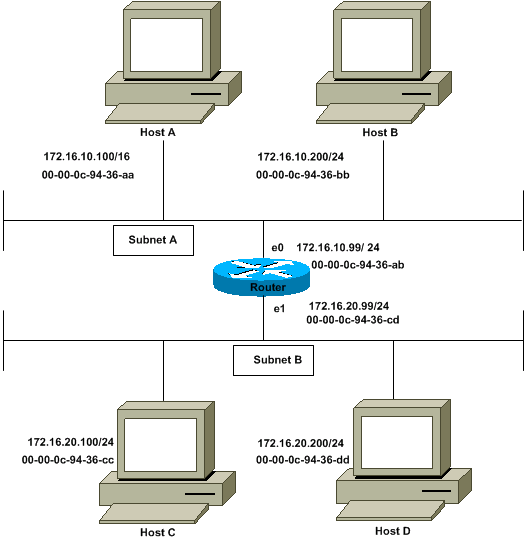
The Host A (172.16.10.100) on Subnet A needs to send packets to
Host D (172.16.20.200) on Subnet B. As shown in the diagram, Host A has a
/16 subnet mask. What this means is that Host A believes that it is
directly connected to all of network 172.16.0.0. When Host A needs to
communicate with any devices it believes are directly connected, it
sends an ARP request to the destination. Therefore, when Host A needs to
send a packet to Host D, Host A believes that Host D is directly
connected, so it sends an ARP request to Host D.
In order to reach Host D (172.16.20.200), Host A needs the MAC address of Host D.
Therefore, Host A broadcasts an ARP request on Subnet A, as shown:
| Sender's MAC Address |
Sender's IP Address |
Target MAC Address |
Target IP Address |
| 00-00-0c-94-36-aa |
172.16.10.100 |
00-00-00-00-00-00 |
172.16.20.200 |
In this ARP request, Host A (172.16.10.100) requests that Host D
(172.16.20.200) send its MAC address. The ARP request packet is then
encapsulated in an Ethernet frame with the MAC address of Host A as the
source address and a broadcast (FFFF.FFFF.FFFF) as the destination
address. Since the ARP request is a broadcast, it reaches all the nodes
in the Subnet A, which includes the e0 interface of the router, but does
not reach Host D. The broadcast does not reach Host D because routers,
by default, do not forward broadcasts.
Since the router knows that the target address (172.16.20.200) is
on another subnet and can reach Host D, it replies with its own MAC
address to Host A.
| Sender's MAC Address |
Sender's IP Address |
Target MAC Address |
Target IP Address |
| 00-00-0c-94-36-ab |
172.16.20.200 |
00-00-0c-94-36-aa |
172.16.10.100 |
This is the Proxy ARP reply that the router sends to Host A. The
proxy ARP reply packet is encapsulated in an Ethernet frame with MAC
address of the router as the source address and the MAC address of Host A
as the destination address. The ARP replies are always unicast to the
original requester.
Upon receipt of this ARP reply, Host A updates its ARP table, as shown:
| IP Address |
MAC Address |
| 172.16.20.200 |
00-00-0c-94-36-ab |
From now on, Host A forwards all the packets that it wants to
reach 172.16.20.200 (Host D) to the MAC address 00-00-0c-94-36-ab
(router). Since the router knows how to reach Host D, the router
forwards the packet to Host D. The ARP cache on the hosts in Subnet A is
populated with the MAC address of the router for all the hosts on
Subnet B. Hence, all packets destined to Subnet B are sent to the
router. The router forwards those packets to the hosts in Subnet B.
The ARP cache of Host A is shown in this table:
| IP Address |
MAC Address |
| 172.16.20.200 |
00-00-0c-94-36-ab |
| 172.16.20.100 |
00-00-0c-94-36-ab |
| 172.16.10.99 |
00-00-0c-94-36-ab |
| 172.16.10.200 |
00-00-0c-94-36-bb |
Note: Multiple IP addresses are mapped to a single MAC
address, the MAC address of this router, which indicates that proxy ARP
is in use.
The interface of the Cisco must be configured to accept and respond to proxy ARP. This is enabled by default. The
no ip proxy-arp
command must be configured on the interface of the router connected to
the ISP router. Proxy ARP can be disabled on each interface individually
with the interface configuration command
no ip proxy-arp, as shown:
Router# configure terminal
Enter configuration commands, one per line.  End with CNTL/Z.
Router(config)# interface ethernet 0
Router(config-if)# no ip proxy-arp
Router(config-if)# ^Z
Router#
In order to enable proxy ARP on an interface, issue the
ip proxy-arp interface configuration command.
Note: When Host B (172.16.10.200/24) on Subnet A tries to
send packets to destination Host D (172.16.20.200) on Subnet B, it looks
into its IP routing table and routes the packet accordingly. Host B
(172.16.10.200/24) does not ARP for Host D IP address 172.16.20.200
because it belongs to a different subnet than what is configured on Host
B ethernet interface 172.16.20.200/24.
The main advantage of proxy ARP is that it can be added to a
single router on a network and does not disturb the routing tables of
the other routers on the network.
Proxy ARP must be used on the network where IP hosts are not
configured with a default gateway or do not have any routing
intelligence.
Hosts have no idea of the physical details of their network and
assume it to be a flat network in which they can reach any destination
simply by sending an ARP request. But using ARP for everything has
disadvantages. These are some of the disadvantages:
- It increases the amount of ARP traffic on your segment.
- Hosts need larger ARP tables in order to handle IP-to-MAC address mappings.
- Security can be undermined. A machine can claim to be another in order to intercept packets, an act called "spoofing."
- It does not work for networks that do not use ARP for address resolution.
- It does not generalize to all network topologies. For example, more than one router that connects two physical networks.